Table of Content
- What Exactly Is an AI Agent?
- The Differences between AI Agents and Traditional Automation
- Fundamental Abilities That Render AI Agents Strong
- The Field Where AI Agents Are Already Contributing
- Developing AI-Based Software Agents Is Different
- Multi-Agent Systems on the Rise
- The Place of AI Agent Builders in the Picture
- Ethical and Practical Issues That You Can Not Overlook
- FAQs
- Long-Term Effect on the Software Construction Process
- Conclusion
AI agents are not another fad in technology. They are a silent evolution of the way software is designed, constructed, tested, and even after-launch improved. I recall the time when automation was considered to be scripting instructions that were strict. We are now referring to systems with the ability to observe, make decisions, and take action with minimum human involvement. Such a transition is big, particularly to developers, founders, and product teams who are attempting to work more quickly without dropping out.
In this paper, I would like to take you on a tour of what AI agents are, how they work under the hood and why they are becoming an inseparable part of contemporary software development. No hype. Real-world wisdom you can put into practice.
What Exactly Is an AI Agent?
An AI agent is a program that can execute functions and make decisions independently depending on how aware it is of the environment and it is able to take action on such decisions to achieve the desired goals. In comparison to the traditional programs, which have to be provided with certain commands, AI agents are dynamic, and they develop along with the feedback.
Simply put, an AI agent absorbs the input, processes the input according to a model and subsequently decides on the course of action. On a higher level, it is able to strategize multi action plan, learn through its results, and coordinate with other agents. That is why AI agents are commonly referred to as coworkers instead of tools by people.
According to OpenAI researcher Lilian Weng, once, the simplest way of defining an agent is that it is anything capable of perceiving its surroundings through sensors and taking action in its surrounding through actuators. Such a definition is quite academic, yet practically, it is software that does not require close management.
The Differences between AI Agents and Traditional Automation
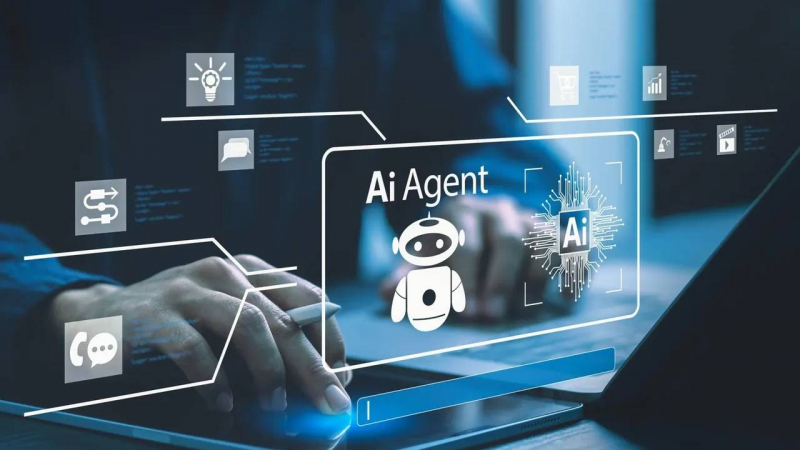
Automation is not new, whereas AI agents have become a basic improvement. Conventional automation is based on set rules. In case X occurs, then Y. AI agents do not operate in that manner.
They are also able to manage ambiguity, make probabilistic choices, and be able to adapt their behaviour depending on the situation. That is why they are particularly strong in the field of software development, where requirements change every minute and edge cases are ubiquitous.
Rather than authoring a bottomless conditional logic, teams can now assign whole workflows to agents that learn as they evolve.
Fundamental Abilities That Render AI Agents Strong
AI agents are unique in that they are a combination of multiple functions in a single system. It is the combination of these that makes them almost alive in their functioning.
They are able to interpret information on APIs, logs, user input, or databases, and interpret it as context as opposed to raw input. Problems can be reasoned out and actions taken depending on the objectives rather than a set of beliefs.
They are free to do what they want to do, be that writing code, getting deployments going, or having users taken care of.
The particularly interesting fact about this is that these capabilities scale. A single agent may be used to accomplish a small task, or even two or more agents may be used to accomplish a complex system.
The Field Where AI Agents Are Already Contributing
The use of AI agents is already being implemented in production settings in addition to laboratory experiments.
Agents are able to produce boilerplate and refactor old code in the coding workflow, as well as propose architectural improvements.
They are used in testing to simulate user behavior, detect edge cases, and rerun tests automatically in case there are changes to the tests.
The only difference is that these agents do not substitute developers. They eliminate redundant thinking and cognitive burden to enable human beings to concentrate on innovative and strategic decisions.
Developing AI-Based Software Agents Is Different
Whether you have ever dealt with AI agents in practice, you can attest to the fact that the experience is vastly different when compared to libraries or frameworks. You are no longer writing guidelines on how to handle any situation. You are stipulating goals and limits.
This change of attitude is a long process. Initially, it would not very comfortable to lose direct control. However, when you get to witness an agent solve a problem that you had not explicitly programmed, it makes sense.
According to Andrej Karpathy, we are shifting the focus of our efforts towards controlling the behaviour of computers. This is exactly the case that is occurring currently.
Multi-Agent Systems on the Rise
Multi-agent over single-agent systems are amongst the strongest trends in AI. Multiple agents do not do everything but cooperate, and this is done by one AI.
One agent may be dealing with user input, another one dealing with performance, and the other one dealing with security. They create an ecosystem together, which changes with time.
This is reflected in the process of real teams, and that is why when there is a multi-agent system, it tends to get more intuitive and durable.
The Place of AI Agent Builders in the Picture
The AI agents are becoming increasingly potent, and the tools applied in their development are more important than ever. Writing of agents per se may be complicated, particularly when there are orchestrations, memories, and integrations in play.
Here is where curated platforms and builders are applicable. To developers wishing to test or implement agents and not reinvent the wheel, resources such as the best AI agent builder by Cybernews provide a realistic overview of platforms that can be flexible and useful at the same time. Rather than guessing which tools can be increased or combined effectively, a comparative study can be useful for aligning technical choices with the actual situation.
Ethical and Practical Issues That You Can Not Overlook
With AI agents, the new challenges come with the new opportunities. Autonomy poses accountability, transparency, and control issues.
Who should take responsibility when an agent decides on issues that affect users? The model, the company, or the developer? They are no longer theoretical issues. They are becoming regular product discussions.
This is why intelligent constraints, logging, and human override mechanisms are necessary. Green adoption does not imply that it should not be adopted responsibly.
FAQs
Are AI Agents Just of Use to Large Companies?
Not at all. Small teams also tend to gain even further since agents will allow them to do more, with less money. An agent that is designed well may take the place of hours of manual labor every week.
Are AI Agents Based on Sophisticated Machine Learning?
In most situations, no. Contemporaneous frameworks deform most of the complexity out. You do not have to train models manually, but you have to know system design and objectives.
Are Developers Replaceable by AI Agents?
This is one of the fears that is raised quite frequently, and, to be honest, it is not to the point. AI agents modify not the necessity of or the absence of developers. There is still a person who has to set objectives, analyze performance, and make judgmental decisions.
Are AI Agents Safe to Use in Production?
Security will be, but implementation will make it. Strict permissions, monitoring and fail-safes are required to agents. They should be treated as potent interns rather than magic black boxes.
Long-Term Effect on the Software Construction Process
In the long run, AI agents would probably be a layer of default in software systems. Similar to databases or APIs, they will be assumed as opposed to optional.
The most significant change is not technical. It’s conceptual. We are leaving behind the stagnant software for dynamic systems. Aged code to evolving systems.
And after working in such a paradigm, it is restricting to go back.
Conclusion
AI agents are a trend that you cannot afford to overlook. They are changing the software development in both subtle and profound ways. They’re reinventing the concept of building software, whether an autonomous workflow or an adaptive system.
Now is the moment to visit this space, particularly if you are a developer, founder, or product thinker. No, not to pursue the hype, but to know how autonomy, intelligence, and collaboration are coming to be fundamental software primitives.
Software is not only written in the future. The negotiating, observing, and improving is done by agents who go hand in hand with us.
Post Comment
Be the first to post comment!