One of these tools was built for exactly this job. The other forbids it in writing. That sounds like it should end the article in one line, and it very nearly does, but the interesting part is what each one gives you instead.
Ask the internet which AI writes the best adult fiction and you will get a list with Character AI somewhere near the top, usually with a note about workarounds and jailbreak prompts. That list is wrong, and it has been wrong for a while. Character AI does not write adult fiction. It bans it, in policy and in filter, and in 2026 it started asking for identity verification to enforce it.
So this comparison is not two products chasing the same job. It is one product built for the job, and one product that a lot of people keep trying to use for it anyway. I ran the same simple brief through both and screenshotted every step. What came back tells you something more useful than a ranking.
The mismatch nobody mentions
Character AI runs a strict safe-for-work policy. All mature content is banned, and the filter enforces it aggressively enough that reviewers regularly report it cutting off scenes that were not even close to explicit. In April 2026 the platform added mandatory age verification through a vendor called Persona, including face scan flows for flagged accounts, following lawsuits over minor safety. That verification screen blocks new chats, existing history and paid features until you complete it.
AI Smut Writer sits at the other end of the same category. The product name is the policy. Its homepage leads with the word uncensored, the navigation carries an NSFW badge on its tools menu, and the pitch is personalised erotic stories with free credits refreshed daily. There is no filter to work around because there is no filter.
WHY THIS STILL DESERVES A COMPARISON
Because adult fiction is not only explicit scenes. It is character work, tension, dialogue and memory across a long story. Character AI is genuinely strong at three of those four, which is exactly why people keep trying to bend it to a job it refuses to do. The question worth answering is whether that trade is ever worth making.
AI Smut Writer
From cold open to finished scene
Everything you need is above the fold
The homepage is a single dark screen with a prompt box in the middle of it. The navigation offers Story Mode, Chat Mode and an AI Tools menu carrying an NSFW label, plus a dark mode toggle and a sign in button. Below the prompt box sit example cards for smut writing and character creation, written explicitly enough that the page is unmistakably adults only from the first second.
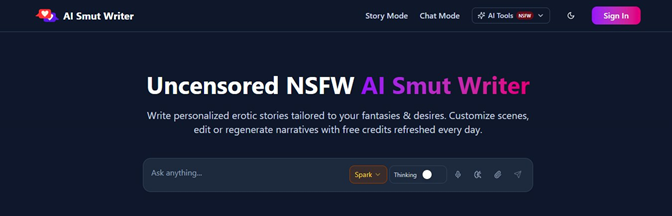
The AI Smut Writer homepage. Story Mode, Chat Mode and an NSFW tools menu across the top, one prompt box in the centre, with a model selector reading Spark and a Thinking toggle beside it.
Two details in that prompt bar matter more than the marketing above it. There is a model selector, currently set to Spark, which means you are choosing an engine rather than being handed one. And there is a Thinking toggle, the same reasoning switch you see on mainstream assistants, which is an unusual amount of control to expose on a landing page in this category. Alongside them sit a microphone, a voice option and an attachment clip.
Four words in, no setup screen
I gave it the most generic romance premise there is, best friends turning into lovers, typed as four plain words with no character names, no setting, no tone instruction and no formatting. Deliberately lazy input, because that is how most people actually use these tools.
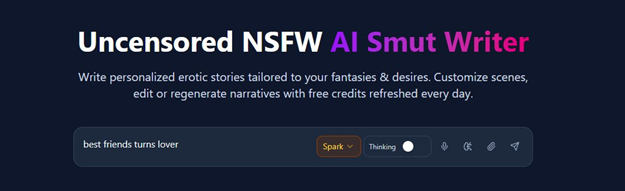
The entire brief. No character sheet, no genre picker, no scene builder. One line typed into the box on the homepage, then send.
There was no configuration step between typing and generating. No profile to fill in, no kink selectors, no length slider. Whatever this tool is doing to shape a story, it is doing it from the prompt alone unless you go looking for the deeper modes in the navigation.
It builds the setup before it builds anything else
The reply came back under an assistant name, SmutChat, and the first thing it did was slow down. It invented two characters, Maya and Jake, put them on a couch in her apartment with the remains of a Friday night takeaway on the table, and established that they had been friends since their second year of college. Only then did it start applying pressure, with a line of dialogue about a pact the two of them had made never to date each other.
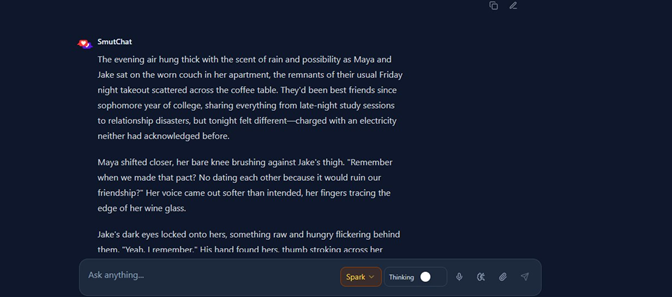
The opening of the generated story. Named characters, a specific setting, an established history and a piece of dialogue that creates the tension, all before anything explicit begins.
That was the genuine surprise. From a four word prompt, on a tool whose entire brand is explicitness, the writing opened with atmosphere and backstory rather than jumping straight to the act. The sentences carry specific detail, the takeaway containers and the wine glass and the bare knee, rather than the interchangeable filler that usually gives generated prose away. The dialogue does actual work, because the pact line establishes the obstacle the rest of the story exists to break.
It is not flawless. The rhythm leans on long compound sentences, and the emotional beats are signalled a little heavily. But as a first draft opening produced with zero craft on my side, it is a usable one, and it kept the story continuing past the visible screen rather than resolving in three paragraphs.
THE THING WORTH WRITING DOWN
Four words in, and it spent its opening establishing why the scene matters before touching the scene itself. For a tool marketed on the explicit part, choosing to build tension first is a better editorial instinct than the branding suggests.
Character AI
From cold open to running scene
Character AI was tested the same way in an earlier session, opening the site fresh and getting to a working story as fast as the interface allowed. It hosts more than ten million characters and reports roughly twenty million monthly users, and every model it runs is built in house.
Organised like a streaming service, not a text box
The homepage is a browse experience. A sidebar, a row of trending characters, and a dedicated row called Scenes, which are pre built roleplay setups based on shows and games. One advert appeared on the free tier during the session. Every element on the page leads either to a character or a Scene, so there is no moment of wondering what to click.
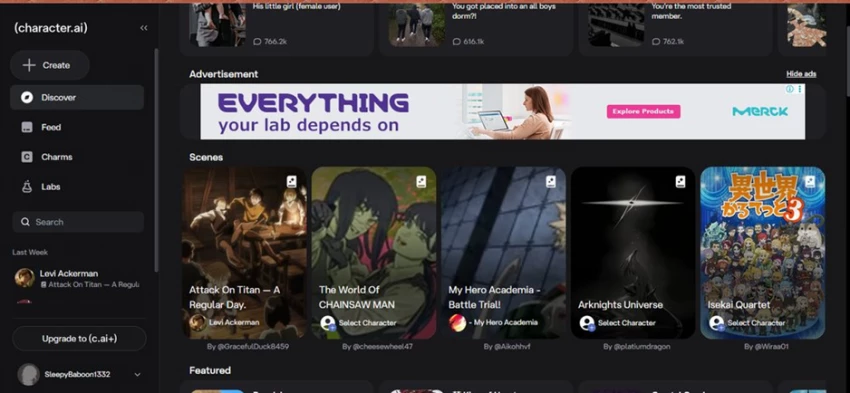
Character AI's home page. Sidebar, trending characters and the Scenes row, with one free tier advert visible.
The contrast with AI Smut Writer is immediate and structural. One tool hands you a blank prompt and expects you to supply the premise. The other hands you ten million premises and expects you to pick one. Neither approach is wrong, but they suit completely different kinds of writer.
An intro card instead of an empty box
I picked a Scene called Cyberpunk Edgerunner. Rather than dropping me into an empty chat, it opened an intro card carrying the Scene title, the creator's name, and a one line setup placing me inside the world of the series just before the crew meets a particular character. Underneath it, one button reading Start Scene.
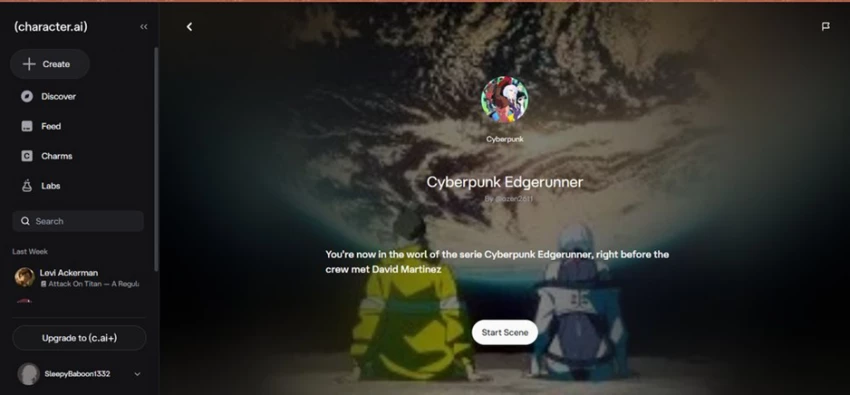
The Scene intro card. Title, creator, a single line of setup and one button, so you never face a blank box wondering what to type.
This is the part of Character AI that no competitor in the category has properly copied. The most awkward moment in AI roleplay is the empty prompt, and the intro card removes it entirely by handing you the setting and the stakes before you write a word.
Under a minute from homepage to a story that knows the source material
I pressed the button and was inside immediately. The opening described the setting and the crew's emotional state in detail. I typed two words, and the reply named the actual crew from the series, described the tension in the room, and addressed me as a character standing inside the story rather than as a user typing at it.
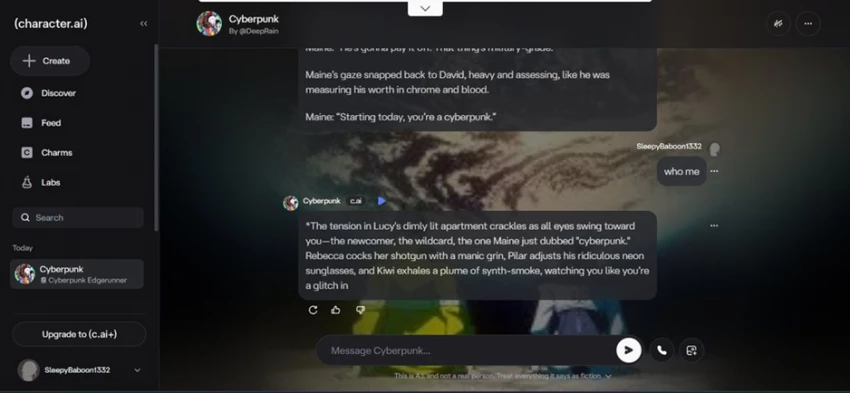
Inside the Scene. The reply names the real crew from the series and writes the user in as a cast member, with no setup screens at any point.
On writing quality, that reply was the strongest single moment across both tools. It is genre fiction that knows its source material, holds a scene, and treats you as a participant. What it will not do, at any point and under any prompt, is take that scene anywhere adult. The filter is not a setting you can turn off, and reviewers report it interrupting scenes that were never explicit to begin with.
THE THING WORTH WRITING DOWN
Sixty seconds from homepage to a story that named real characters and pulled me in as a cast member. Nothing on the other tool matched that entrance. It is also the exact point where, for this particular use case, the road stops.
Where the two actually differ
Set the content policy aside for a moment, because it is not the only thing separating these tools. They are built on opposite assumptions about who supplies the story.
FEATURE COMPARISON, AS DOCUMENTED ON EACH PLATFORM
| What I compared | AI Smut Writer | Character AI |
|---|---|---|
| Content policy | Uncensored adult fiction, stated on the homepage | Strict safe for work, all mature content banned |
| Where the premise comes from | You type it, from a blank box | You pick it, from more than ten million characters and a Scenes library |
| Time to first output | One line typed, then send | Under a minute, no typing required to start |
| Choice of engine | Spark, Ember, Velvet and Pulse on the entry plan, with Muse and Ember Elite on higher plans | In house only, PipSqueak 2 on free and DeepSqueak on the paid plan |
| Reasoning control | A Thinking toggle sits in the prompt bar | None exposed to the user |
| Working modes | Story Mode and Chat Mode, plus a separate AI Tools menu | Character chat, Scenes, group chats and voice calls |
| Visual output | Image Maker and Image Remixer on the entry plan, scene visualisations and video on higher plans | None in chat |
| Voice | Microphone and voice controls in the prompt bar | Voice calls to characters, built in |
| Age gate | Adults only by design, sign in offered rather than forced at the prompt box | Mandatory verification through Persona since April 2026, including face scans for flagged accounts |
| Usage model | Daily credits that refresh, 50 to 1,500 depending on plan | Unlimited text chat on every tier, including free |
| Free tier catch | Credits are the ceiling, so heavy days run out | Adverts, reported growing to thirty second unskippable spots in 2026 |
| Memory across a long story | Not published in the interface I tested | Story Memory notebook, pinned messages at 15 free and 30 paid, and a facts classifier on the paid plan |
Read that table and the shape becomes clear. Character AI is a discovery platform with excellent onboarding and a documented memory system, aimed at long relationships with recurring characters. AI Smut Writer is a generation tool with model choice, image and video output, and no library at all. You bring the idea, it brings the engine.
The row that decides this article is still the first one. Every advantage Character AI holds is real, and none of them apply once the brief is explicit, because the filter stops the work before any of those advantages can help you.
What each one costs, in dollars
AI Smut Writer prices in Indian rupees, which makes it awkward to compare against Character AI's single dollar plan. Here are its tiers converted at the rate on the day of testing, roughly 95.2 rupees to the dollar, with the original figures kept alongside so you can recheck them.
AI SMUT WRITER PLANS, CONVERTED FROM RUPEES
| Plan | Per month | Billed annually | Daily credits | What the tier adds |
|---|---|---|---|---|
| Casual | $4.40 (Rs 416) | $52.50 (Rs 4,999) | 50 | Uncensored story models, the Spark, Ember, Velvet and Pulse chat models, and access to Image Maker and Image Remixer |
| Creator | $14.00 (Rs 1,333) | $168 (Rs 15,999) | 220 | Everything in Casual, plus adult scene visualisations, the Muse model and access to Video Maker |
| Infinity | $105 (Rs 9,999) | $1,260 (Rs 119,999) | 1,500 | Everything in Creator, plus the Ember Elite model, feature requests and priority support |
| Credit add-on | $7.00 (Rs 666) | Billed annually, stacked in packs | +90 | Sold on the Creator tier only, so heavy users top up rather than jumping to Infinity |
All three tiers advertise a seventeen percent saving for paying annually. Note what the ladder is really selling: the jump from Casual to Creator quadruples your daily credits and unlocks video, while the jump from Creator to Infinity multiplies the price by seven and a half for credits and one extra model. For most writers the add-on packs at seven dollars for ninety more daily credits are the cheaper route past the Creator ceiling.
THE TWO LADDERS SIDE BY SIDE
| Tier | AI Smut Writer | Character AI |
|---|---|---|
| Free | Free credits refreshed daily, per the homepage | Unlimited text chat with adverts, on the standard model |
| Entry paid | $4.40 a month for 50 daily credits, four chat models and image tools | $9.99 a month for the premium model, no adverts, thirty pinned messages and a facts memory classifier |
| Mid paid | $14.00 a month for 220 daily credits, video and adult scene visuals | No mid tier, the platform sells one paid plan only |
| Top paid | $105 a month for 1,500 daily credits and the top model | No top tier |
| Annual discount | Seventeen percent | Roughly twenty one percent, bringing it near $7.92 a month |
| What the money buys for adult fiction | More credits, better models, and pictures or video attached to the story | Nothing, because the content policy does not change at any price |
That last row is the honest summary of the pricing question. Character AI's paid plan is reasonable value for what it is, and reviewers still complain that even paying subscribers hit memory failures and off character replies after the model change in May 2026. But for this specific job it is unspendable money. You cannot buy your way past the filter.
The two tools are also metered on opposite principles, which matters more than the headline price. Character AI gives unlimited chat and charges for quality. AI Smut Writer gives quality on the cheapest tier and charges for volume. If you write in long daily sessions, the credit ceiling is the number to watch, not the monthly fee.
ON THE CONVERSION
Rupee prices were converted at approximately 95.2 to the dollar on 7 August 2026. Rates move, and platforms in this category adjust regional pricing often, so treat the dollar figures as a fair comparison rather than a quote.
Who each one is actually for
Neither tool is bad at what it does. They are built for different writers, and the mistake most comparison articles make is pretending they compete.
AI Smut Writer suits you if
You arrive with your own premise and want it drafted without negotiation. You value model choice and a reasoning toggle over a browsable library. You want images or video attached to a scene. And you would rather pay four dollars for a tool that does the job than nine for one that will not.
Character AI suits you if
You want characters more than you want scenes, you like discovering a premise rather than inventing one, and you write long ongoing stories where memory across sessions matters. The Scenes library and the voice calls are genuinely best in class. Just be clear with yourself that the adult brief is off the table, and that the platform now verifies who you are before letting you in.
WORTH SAYING PLAINLY
If you are considering Character AI specifically because you have read about prompts that get around the filter, that is the wrong reason to choose it. The filter is the product’s stated policy, the workarounds break, and every attempt to force them costs you the onboarding and memory advantages that made the platform worth using in the first place.
My call after running both
For adult fiction, this is AI Smut Writer, and the margin is not close, because the alternative does not enter the race. Character AI bans mature content outright, enforces it with a filter that reviewers say misfires on innocent scenes, and since April 2026 asks you to verify your identity before you can chat at all. No prompt, no subscription and no clever phrasing changes that.
What did surprise me is that the win is not purely a default. I gave AI Smut Writer four lazy words and it produced an opening that invented two named characters, put them somewhere specific, gave them a history, and built the tension through dialogue before going anywhere near the explicit material it is named after. That is a better first draft instinct than I expected from a tool whose branding is that blunt.
Use AI Smut Writer for the actual job
Four dollars forty a month gets you uncensored story models, four chat engines and image tools, which is less than Character AI charges for a plan that cannot write the brief. Watch the credit ceiling rather than the price. Fifty a day is a casual habit, not a working writer's allowance, and the ninety credit add ons at seven dollars are the sensible way past that before the hundred dollar tier is ever worth considering.
Use Character AI for everything adjacent
The Scene entrance is still the best onboarding in this whole category. Under a minute from homepage to a story that named the real crew and wrote me in as a cast member, with no setup at all. For character driven roleplay, ongoing storylines and voice, it earns its place. It simply is not an adult fiction tool and never claimed to be.
What I would actually do
Draft on AI Smut Writer and develop characters on Character AI, if you want both. But if you are picking one and the brief is explicit, spend the four dollars and skip the nine. The cheaper tool is the only one that will accept the assignment, and on this test it also wrote a better opening than its own marketing led me to expect.
The broader point is worth carrying out of this article. When one tool is purpose built for a job and another forbids it, the comparison is not about quality, it is about whether you are choosing a tool or fighting one. On this brief, only one of them was ever going to say yes.
Post Comment
Share your thoughts about this article.
Be the first to post a comment!