Beauty has quietly become one of the most aggressive enterprise adopters of generative AI. The harder question for technology and business leaders is whether the industry's own performance metrics, and its AI-generated marketing, can survive the scrutiny now arriving.
For a sector built on emotion, touch, and scent, beauty has turned out to be an unlikely front-runner in enterprise artificial intelligence. Cosmetics companies sit on enormous volumes of structured consumer and formulation data, they sell products whose outcome is notoriously hard to judge online, and they market almost entirely through imagery. Those three traits make the category unusually well suited to generative models, and the money is following. Analysts, however, cannot agree on how big the opportunity is, which is the first sign that this shift deserves closer reading than the usual trend roundup.
Research and Markets values the AI in beauty and cosmetics segment at roughly 5.3 billion dollars in 2026, reaching about 10.86 billion by 2030 at a 19.6 percent compound annual rate. InsightAce Analytic pegs the same market at 13.34 billion by 2030. A separate 2026 forecast stretches the horizon to 33.75 billion by 2035. The wide spread reflects a real definitional problem: no one agrees where a virtual try-on widget ends and a formulation model begins. What is not in dispute is direction. McKinsey has estimated that generative AI alone could add 9 to 10 billion dollars of value to the beauty sector, and the largest players are building as if that estimate is conservative.
From selfie filters to foundation models
The clearest way to understand the change is to stop looking at consumer apps and start looking at infrastructure. The first wave of beauty AI was cosmetic in both senses: augmented-reality lipstick overlays and skin-analysis quizzes bolted onto e-commerce pages. The current wave is an enterprise technology build-out, and L'Oreal is the case study that makes the pattern legible.
L'Oreal's advantage is not a clever app. It is data. Independent analysis of the company's strategy puts its proprietary store of cosmetic-science and formula-performance records at more than 16,000 terabytes, an asset that becomes more valuable, not less, as models are trained on it. In January 2025 the company announced a partnership with IBM to build a custom Formulation Foundation Model, described as a first of its kind, trained on that historical formula data to accelerate the search for sustainable raw materials and stable new formulas. This is generative AI applied to chemistry rather than content, and it is the part of the story most consumer coverage misses entirely.
The infrastructure layer runs deeper still. L'Oreal has worked with Nvidia on 3D product visualization and an internal development tool it calls AI Refinery, with Adobe and Google on its in-house generative content lab CreAItech, and, as of a June 2026 announcement at VivaTech, with OpenAI on agentic commerce and research workflows. One early product of that last partnership brings Maybelline's virtual makeup try-on, powered by the company's ModiFace technology, directly inside ChatGPT. Internally, the company reports training 73,000 employees in generative AI and deploying tools it calls L'OrealGPT and personal AI companions. By the end of 2025, its Beauty Tech services logged more than 120 million uses across 66 countries and 31 brands, and its Beauty Genius assistant alone generated more than 1.1 million conversations in the United States.
Read as a whole, this is not a beauty company dabbling in AI. It is a large enterprise assembling a proprietary data moat, a bespoke foundation model, a multi-vendor compute and content stack, and an organization-wide training program. That is a template any data-rich business can recognize, which is precisely why it belongs in a technology publication rather than a style column.
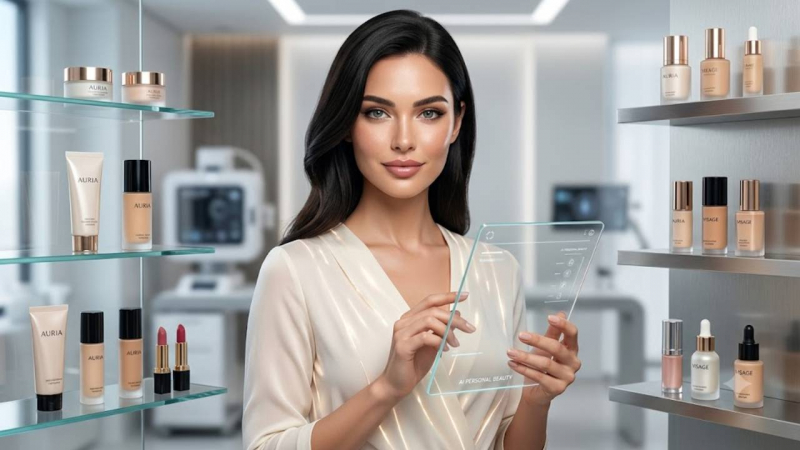
What AI changes at the point of purchase
On the storefront, generative and computer-vision AI target one expensive problem: uncertainty. A shopper cannot feel a texture or test a shade through a screen, and that hesitation drives abandoned carts and returns. Shade-matching systems now read skin tone and undertone from a selfie or a live camera and map the result to specific products. Perfect Corp, whose beauty apps have passed 950 million downloads, markets a finder it says can distinguish tens of thousands of skin tones, and Procter and Gamble's Olay Skin Advisor has reported roughly 90 percent accuracy in estimating skin age.
The larger opportunity sits in products whose result a buyer cannot see until hours after checkout. Foundation, at-home hair color, and self tan all develop differently on each person, which is why tools that predict an outcome on the shopper's own skin tend to convert well and reduce the costly returns that follow a bad guess. The commercial logic is simple: confidence at the moment of decision turns browsers into buyers.
The measurement problem no one wants to name
Here the reporting usually stops, and here is where a business reader should press hardest. The figures used to justify these deployments are impressive and largely unaudited. The commonly repeated claim that virtual try-on lifts conversion 20 to 40 percent, and the headline reductions in returns, come overwhelmingly from vendor case studies and trade-press write-ups rather than peer-reviewed work. Some cited numbers are eye-catching precisely because they are single-deployment anecdotes: a 200 percent conversion increase here, a 320 percent lift there. Treated as marketing, they are fine. Treated as a basis for capital allocation, they are thin.
The returns story is more subtle than the vendor decks suggest, and it cuts against the industry's favorite talking point. Beauty already has one of the lowest return rates in retail, roughly 4 to 12 percent online against a category-wide e-commerce average near 19 to 20 percent, according to benchmark analysis from e-commerce consultancy Eightx. That low number is frequently misread as satisfaction. In reality it is partly structural: hygiene and final-sale rules, backed in Europe by the Consumer Rights Directive's exemption for unsealed cosmetics, make many beauty returns simply impossible. A customer who receives a mismatched foundation often cannot send it back, so they keep it, never reorder, and vanish. The industry calls the visible metric a return rate; the more honest label is silent churn. Where returns are permitted, foundation and concealer run near 23 percent, and independent estimates attribute a large majority of beauty returns to products that looked different in person.
The implication for a technology leader is specific. If AI shade-matching works, its payoff will not show up cleanly in a return-rate chart that was already suppressed by hygiene policy. It will show up in repeat-purchase and retention data over 30, 60, and 90 days, the exact cohorts that a 2026 study of AI try-on across luxury platforms, covering 1.2 million shoppers in 216 countries, recommends tracking separately for users and non-users. Any beauty AI business case that leans on conversion-lift screenshots and ignores retention cohorts is measuring the wrong thing.
The compliance reckoning arriving in 2026
The most consequential development for beauty AI in 2026 has nothing to do with try-on accuracy. It is regulatory, and beauty is unusually exposed because its marketing is built on aspirational faces and visible results, the two things new disclosure laws are designed to police.
In the United States, the Federal Trade Commission moved from general principle to specific enforcement across 2025 and into 2026. It brought its first action targeting undisclosed AI-generated advertising content in late 2025, updated its endorsement guidance to cover synthetic media and AI-generated personas, and now treats undisclosed AI imagery as a potential material misrepresentation where consumers would expect a real person or an unaltered result. Trade analyses put the statutory penalty ceiling above 53,000 dollars per violation in 2026, following a reported 40 percent rise in FTC enforcement activity the prior year. New York went further at the state level: an amendment to its General Business Law, effective in June 2026, requires conspicuous disclosure when an advertisement knowingly features an AI-generated synthetic performer that a reasonable viewer would take for a real human. In the European Union, Article 50 of the AI Act requires AI-generated or manipulated media to be marked in machine-readable form and disclosed to users, with serious violations exposed to fines measured as a percentage of global turnover.
For a beauty brand, this reframes generative content from a pure efficiency win into a governance obligation. An AI-generated model with flawless skin, a synthetic before-and-after, or an AI persona endorsing a serum now carries disclosure risk in multiple jurisdictions at once. It is notable that L'Oreal, according to strategic analysis of its approach, has publicly committed to not using AI-generated faces to support product claims, positioning restraint itself as a trust signal. Provenance standards such as the C2PA content-credentials framework are moving from optional to expected, and the brands treating AI disclosure as a compliance workflow rather than an afterthought will be the ones still advertising freely in two years.
What it means for technology and business leaders
The beauty industry is a useful mirror for any consumer business weighing generative AI, because it is running the full experiment in public: heavy infrastructure investment, real consumer-facing deployment, contested ROI, and a regulatory tightening all at once. The lesson is not that AI is transforming beauty. That much is settled. The lesson is that the winners are treating it as an enterprise data and governance program, not a feature.
Post Comment
Share your thoughts about this article.
Be the first to post a comment!