Table of Content
- These two tools are solving different problems
- Specifications side by side
- Seven rounds that decide it
- Models and output quality, in numbers
- Pricing, credits and what it really costs
- Licensing and commercial rights
- Trust, privacy and the consent problem
- Match the tool to the job
- Wider Field
- Final Call
One is a fast browser toolkit for editing photos you already have. The other is a Canva owned generative studio with its own foundation models. They compete on the same search term and almost nowhere else.
MYIMG AI Photo to cartoon, face swap, upscaling and headshots. Credit based, browser only, built for speed. | LEONARDO AI Text to image, canvas editing, custom model training, video and 3D. Subscription based, built for control. |

Generative models turn a prompt into pixels. Editors turn your pixels into different pixels.
THE SHORT ANSWER
Leonardo wins for creating images. MyImg wins for retouching the ones you have.
If your question is "which tool makes better AI images", Leonardo AI is the stronger choice for almost everyone. It runs its own foundation models, brokers access to most of the leading third party models, offers documented commercial licensing, and sits inside Canva after a July 2024 acquisition. That is a level of accountability MyImg AI does not have.
MyImg AI is not really competing in that category. It is an editing suite with a text to image feature bolted on, and its best work happens when you feed it a photo rather than a prompt. It is also a platform with a poor independent trust score and a large adult content business attached, which changes the calculation for anyone using it professionally.
PICK MYIMG AI IF You want a fast edit and then you want to leave. Cartoon versions of a selfie, a face swap for a group chat, an old photo cleaned up. Low effort, low cost, no learning curve, and nothing that matters riding on it. | PICK LEONARDO AI IF You need images that did not exist before. Concept art, game assets, product visuals, thumbnails, marketing sets with a consistent look. Slower to learn, far more headroom, safer to use commercially. |
These two tools are solving different problems
MyImg AI in detail
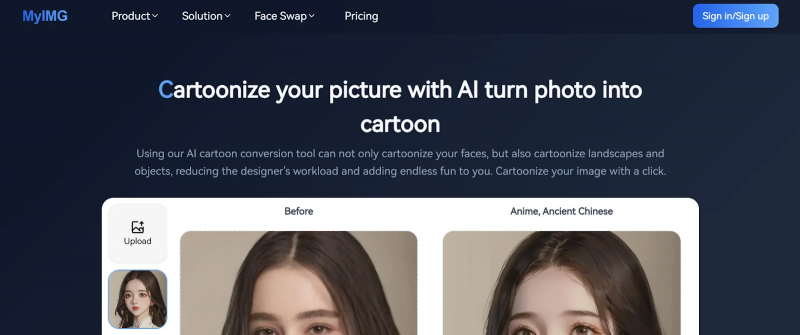
MyImg starts with a photo you already took.
A browser based image and video editor. The headline feature is one click photo to cartoon conversion with preset styles including anime and Ghibli inspired looks, and third party testing puts a typical cartoonification at roughly four to five seconds.
Around that sits a wide grab bag: face swap for photos and video, image unblurring, enhancement, restoration, AI headshots, style transfer, in painting, and a text to image generator. Uploads and downloads use ordinary JPG and PNG.
The domain was registered in March 2024 through Cloudflare, and traffic estimates from early 2026 put it near 3.8 million monthly visits, so it is small but far from obscure.
Leonardo AI in detail
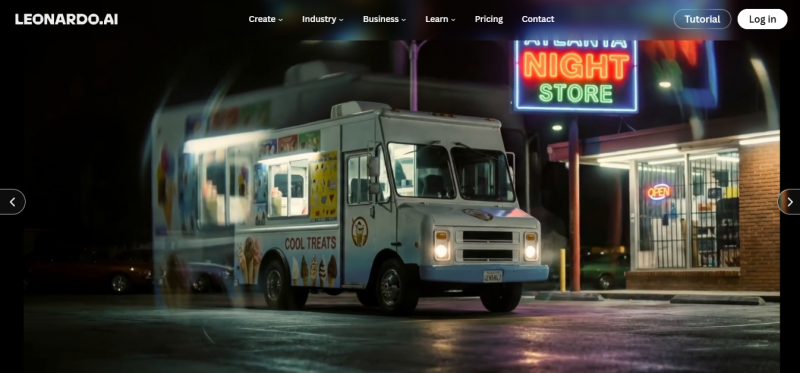
Leonardo starts with a prompt and a blank canvas.
A Sydney based generative media platform, acquired by Canva in July 2024 after raising over 58 million Australian dollars and reaching roughly 19 million users. Phoenix was billed as Australia’s first generative AI foundation model.
Today the in house line up is Phoenix, Lucid Origin and Lucid Realism, and the platform also brokers access to third party models including FLUX, Ideogram 3.0, GPT Image, Nano Banana, Seedream, Kling, Veo, Hailuo, LTX and Rodin for 3D.
Around generation sit AI Canvas, Realtime Canvas driven by latent consistency models, custom model and element training, Universal Upscaler, outpainting, background removal, motion video and a production API with Python and TypeScript SDKs.
Specifications side by side
Mar 2024 MYIMG DOMAIN REGISTERED | 3.8M MYIMG MONTHLY VISITS, EARLY 2026 | Jul 2024 CANVA ACQUIRED LEONARDO | 19M LEONARDO USERS AT ACQUISITION |
| ATTRIBUTE | MYIMG AI | LEONARDO AI |
|---|---|---|
| Company | Independent operator, ownership not publicly disclosed | Leonardo.Ai, Sydney, part of Canva since July 2024 |
| Core purpose | Editing and transforming existing photos and video | Generating new images, video and 3D assets from prompts |
| In house models | None disclosed | Phoenix, Lucid Origin, Lucid Realism |
| Third party models | Not offered | FLUX, Ideogram 3.0, GPT Image, Nano Banana, Seedream, Kling, Veo, Hailuo, LTX, Rodin |
| Editing tools | Cartoonify, face swap, unblur, enhance, restore, headshots, in painting | AI Canvas, Realtime Canvas, in painting, outpainting, upscaling, background removal |
| Model training | No | Yes, custom models and elements from your own datasets |
| Video | Face swap on video, up to 4K on higher packs | Motion models plus brokered Veo, Kling, LTX, Seedance, Hailuo |
| 3D | No | Yes, via Rodin |
| Developer API | Not documented | Yes, REST with webhooks, MCP integration, Python and TypeScript SDKs |
| Free tier | Roughly 100 monthly credits, around 10 daily trials, watermarks on some outputs | 150 fast tokens per day, reset every 24 hours, no rollover |
| Billing | One off credit packs | Monthly or annual subscription, up to 20 percent off annually |
| Trust score | Rated 35 out of 100 with a blacklist warning by GridinSoft | No comparable warnings, established corporate parent |
| Adult content | Explicitly marketed, including clothes removal and deepnude tools | Prohibited by content policy |
Seven rounds that decide it
Each bar shows where the advantage sits. Orange is MyImg AI, blue is Leonardo AI.
| Round 1. Image generation quality | LEONARDO | ||
| MYIMG AI | LEONARDO AI | ||
MYIMG AI Text to image exists but no model is named, prompt adherence is loose, and fine detail breaks down. There is no public benchmark placement of any kind. | LEONARDO AI Lucid Origin entered the Artificial Analysis image leaderboard at number six on launch, with the Ultra variant rated comparable to FLUX.1 Kontext max and the Fast variant to Kontext pro. | ||
| Round 2. Editing existing photos | MYIMG | ||
| MYIMG AI | LEONARDO AI | ||
MYIMG AI Home turf. Cartoonify, unblur, restore, enhance, swap a face, generate a headshot. Each is a single purpose button, and reviewers consistently rate the stylisation tools as genuinely good. | LEONARDO AI The canvas edits uploads through in painting and image guidance, and the Universal Upscaler is strong, but you assemble the result yourself. Slower for a one minute cleanup. | ||
| Round 3. Creative control | LEONARDO | ||
| MYIMG AI | LEONARDO AI | ||
MYIMG AI Presets and intensity sliders. If the preset does not match your idea, there is no second lever to pull, and reviewers note inconsistent results on complex source images. | LEONARDO AI Model choice, negative prompts, ControlNet style image guidance, PhotoReal, Alchemy, transparency, aspect ratios, upscalers, and custom trained models for a repeatable house style. | ||
| Round 4. Speed and learning curve | MYIMG | ||
| MYIMG AI | LEONARDO AI | ||
MYIMG AI Upload, click, done, with cartoonification finishing in about four to five seconds. Basic generation is usable without signing up at all. | LEONARDO AI Lucid Origin Ultra takes around 22 seconds per image and the Fast variant around 12. Add prompt learning and model selection on top of that. | ||
| Round 5. Pricing model | DEPENDS ON VOLUME | ||
| MYIMG AI | LEONARDO AI | ||
MYIMG AI One off credit packs with no recurring charge, which genuinely suits occasional use. Free output can carry watermarks and reduced resolution. | LEONARDO AI A usable permanent free tier, then subscriptions from about 12 US dollars a month. Better value at volume, worse if you need three images a year. | ||
| Round 6. Commercial use | LEONARDO | ||
| MYIMG AI | LEONARDO AI | ||
MYIMG AI Licensing terms are thin, and no model provenance is published, so you cannot tell a client what generated their asset. | LEONARDO AI Documented commercial rights, with Lucid Origin explicitly cleared for personal and professional work. Free tier generations are public and carry a non exclusive licence rather than ownership. | ||
| Round 7. Trust and safety | LEONARDO | ||
| MYIMG AI | LEONARDO AI | ||
MYIMG AI GridinSoft rates the domain 35 out of 100 with a blacklist warning and advises against payments. Reviewers have logged undelivered credits and unanswered support mail. | LEONARDO AI A named company with a corporate parent, published terms, enterprise customers, developer documentation and an accountable support process. | ||
Models and output quality, in numbers
This is the clearest gap between the two, because only one of them publishes anything measurable.
LEONARDO, WHAT IS DOCUMENTED
• Lucid Origin ships in Fast and Ultra modes, with token cost scaling by image size and resolution, and is available on free and paid tiers alike.
• On launch it debuted at number six on the Artificial Analysis image leaderboard, a step up from the older Phoenix models.
• Generation time measured at roughly 22 seconds for Ultra and 12 seconds for Fast, slower than Seedream 3.0 at around 5 seconds but faster than GPT-4o image generation at around 51 seconds.
• On the top API tier, Lucid Origin Ultra worked out near 87 US dollars per thousand images and the Fast variant near 18 dollars, which sits in the premium band alongside FLUX.1 Kontext max.
• Strong in image text rendering, which matters for thumbnails, posters and any design with words baked in.
MYIMG, WHAT IS DOCUMENTED
• No named model, no published benchmark, no stated training data or provenance.
• Cartoonification lands in roughly four to five seconds, and text to image is described as similarly fast.
• Reviewers report variable quality on face swaps and video, particularly with low resolution source material.
• Output formats are JPG and PNG, with resolution capped on the free tier.
HOW TO READ THIS An unnamed model is not automatically a bad model, but it makes quality unverifiable and licensing unprovable. For personal use that is a shrug. For client work it is a liability, because you cannot answer basic questions about what produced the asset you are billing for. |
Pricing, credits and what it really costs
Leonardo plans and tokens
Leonardo publishes clear tiers and charges by token rather than per image, so cost moves with GPU load and settings rather than a flat rate.
| PLAN | MONTHLY | WHAT YOU GET |
|---|---|---|
| Free | 0 USD | 150 fast tokens daily, reset every 24 hours, no rollover, generations public |
| Essential | about 12 USD | Private generations, faster queue, more concurrent jobs, unused tokens roll for up to 3 months |
| Premium | about 30 USD | Higher allowance, heavier use of Alchemy, upscalers and motion |
| Ultimate | about 60 USD | Largest solo allowance, best value for video heavy work |
| Team | from about 72 USD | Three seats, shared workspace |
In practice a standard image runs about 4 to 6 tokens, so the free 150 tokens translate to roughly 25 to 37 images a day. Turn on refiners and that can climb to 10 to 15 tokens per image, cutting the free tier to a dozen or so images. Video is the real budget killer: an eight second motion render can consume tokens comparable to hundreds of stills. Annual billing takes up to 20 percent off every solo and team tier.
MyImg credit packs
MyImg sells one off credit bundles rather than subscriptions, and each feature consumes a different amount, so the value of a pack depends entirely on what you use it for.
| PACK | CREDITS | TYPICAL INCLUSIONS |
|---|---|---|
| Free | about 100 monthly | Around 10 daily trials, capped resolution, watermarks on some outputs |
| Entry | 1,000 plus 50 bonus | Video up to 60 seconds in HD, multi face swap, 500 image swaps and 500 enhancements per month, priority queue, no watermark |
| Mid | 5,000 plus 2,000 bonus | Video up to 120 seconds in 4K, 8,000 image swaps and 8,000 enhancements per year, priority queue, no watermark |
| High | 15,000 | Bulk allowance for heavy or batch use |
BUYER WARNING Multiple reviews record users who paid for a pack and never received the credits, with support mail going unanswered. If you decide to try MyImg, start on the free tier and avoid large upfront purchases until you have confirmed that credits actually arrive. |
Licensing and commercial rights
Leonardo grants commercial use, with one catch worth internalising: on the free tier your generations are public and come with a non exclusive licence rather than outright ownership. If a client asset needs to be private and exclusive, that alone is the reason to be on a paid plan. Lucid Origin is explicitly cleared for professional work across tiers.
MyImg’s position is far less clear. There is no published model provenance, the terms are thin, and there is no practical route to a written licensing assurance given the support record. For anything that will appear in an advertisement, on a product page or in a deliverable a client pays for, that is a genuine risk rather than a formality.
A simple test: if a client asked you tomorrow to prove you have the right to use an image, which platform could you answer with a link. That is your answer.
Trust, privacy and the consent problem

Every upload leaves your device. On a low trust platform, that is the whole risk in one sentence.
IMPORTANT Alongside its cartoon tools, MyImg AI markets itself as a free adult content platform, including clothes removal, deepnude generation, explicit video face swaps and adult image generation from prompts. Creating sexualised images of a real person without their consent is illegal in a widening set of jurisdictions, including under UK and Australian law and a growing number of US state and federal rules. It is also grounds for platform bans, civil claims and criminal charges. There is no version of this that becomes safe because a website offers the button. Separately, GridinSoft rates the domain 35 out of 100 with a blacklist warning and recommends avoiding sign in and payments. Any photo you upload leaves your device, and that exposure matters most for images of children, colleagues, clients or anyone who did not ask to be there. |
This is not a footnote to a feature comparison. If you are choosing a tool for a business, a client project or anything touching another person’s likeness, a platform’s posture on consent and data handling is a first order question. Leonardo AI is the more defensible choice on that axis by a wide margin, and the gap is not close.
Match the tool to the job

Start with the question of whether you are working from a blank page or a photo.
MYIMG AI, REASONABLE FIT FOR
• Turning your own photos into cartoon or anime portraits
• Restoring or sharpening old family pictures
• A quick profile picture without a photo shoot
• Casual one off edits where a subscription makes no sense
• People who want zero learning curve and low stakes
LEONARDO AI, REASONABLE FIT FOR
• Concept art, character design and game assets
• Marketing and product visuals with a consistent look
• Thumbnails and posters that need readable text in the image
• Teams needing custom trained models, a canvas or an API
• Commercial work where licensing has to be defensible
Wider Field
Alternatives worth knowing
Search interest pushes these two names together, but they were never built for the same person. Asking whether MyImg beats Leonardo at generating images is close to asking whether a photo filter app beats a camera. If neither fits, the real field looks like this.
• Midjourney for painterly, aesthetic first output where you care more about beauty than direction.
• Ideogram for typography heavy graphics, at a lower entry price than Leonardo.
• Adobe Firefly if your team already lives in Photoshop and Illustrator, where the integration beats raw model quality.
• FLUX via any hosted provider if you want current model quality with predictable per image pricing rather than credits.
• Canva itself, which now ships Leonardo’s models inside a design tool most teams already pay for.
For the editing side, mainstream photo enhancers and upscalers cover most of what MyImg’s benign tools do, without the adult content business attached.
Final Call
Leonardo AI is the better AI image tool. MyImg AI is the faster photo toy.
For generating images, Leonardo AI wins on model quality, control, licensing, developer access and trust, and it is the one to choose if AI images are part of how you work. MyImg AI earns a narrow lane: quick, cheap, entertaining edits of photos you already own, with real caveats about payments, privacy and what else the platform sells.
If you are still undecided, spend one evening on Leonardo’s free daily tokens. It costs nothing and it will tell you more than any comparison article, including this one.
Post Comment
Share your thoughts about this article.
Be the first to post a comment!